
Mid-South hydroseed and erosion work
Hydroseeding in Memphis, TN
Grass sprayed on, soil held in place: lawns, slopes and job sites across Shelby County and the Mid-South.
- We walk every site before quoting, and the quote comes in writing
- Grass picked for how much sun, shade and season your yard actually gets
- A watering plan left with every new lawn
Why Bare Ground Does Not Stay Put Here
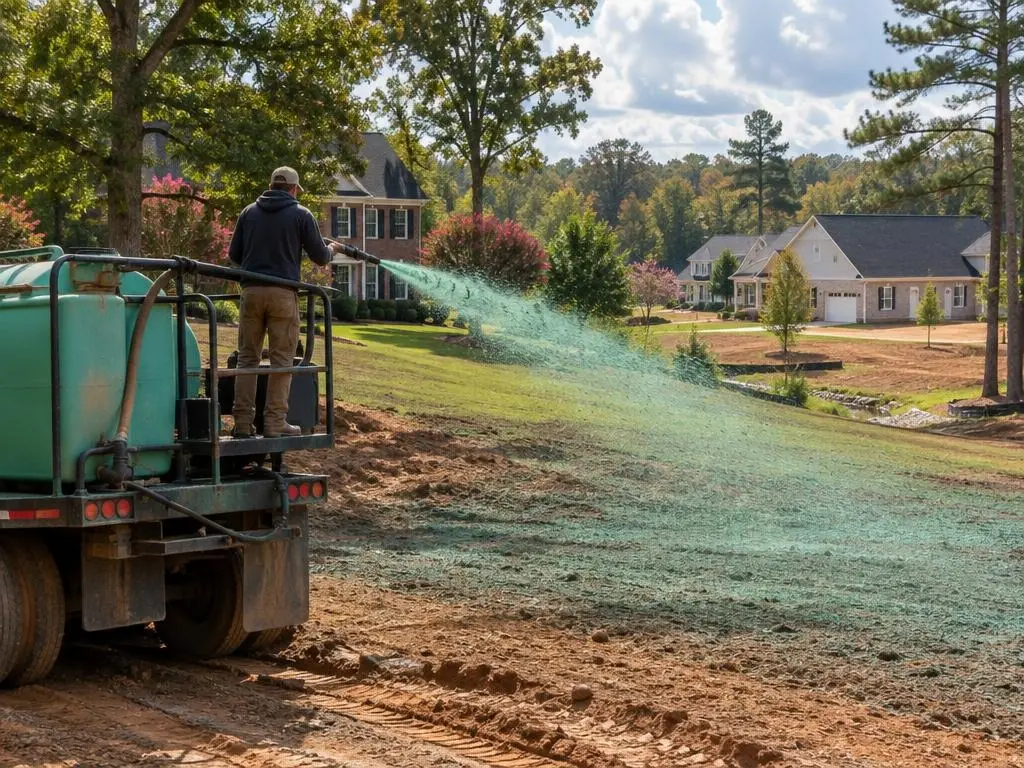
Hydroseeding in Memphis is mostly about speed: getting grass and a protective mulch on bare ground before the next storm moves it. We spray a slurry of seed, fertilizer, wood fiber mulch and tackifier in a single pass, and the wet mat bonds to the soil the same day. That one layer feeds the seed, holds moisture against the summer sun, and keeps rain from lifting the silt off your yard. We work on new-home lots, torn-up yards after drainage or utility work, banks and ditches, commercial pads and subdivision common areas from Midtown out to the county line and into north Mississippi and eastern Arkansas.
Loess: good soil that hates being bare
Memphis sits on the Fourth Chickasaw Bluff, part of a band of high ground built from Pleistocene loess, which is wind-blown silt. Along the bluffs that silt can be up to 70 feet thick, and it thins out as you go east. The USDA's Memphis soil series, of large extent across the lower Mississippi Valley, is a very deep, well drained silt loam formed in loess more than 4 feet thick, with medium to very high runoff. Its upper subsoil is a brown silty clay loam, and the whole profile runs moderately to very strongly acid unless it has been limed. On broader ridgetops you also find soils like Loring, which have a dense fragipan that slows water moving down. For a lawn, that means two things: the topsoil grows grass well, and once the cover is gone, the silt washes faster than almost anything else. A covered surface on day one matters more here than in sandier or rockier places.
Steep little ravines
Geologists describe the bluff country as having very steep valleys and higher-gradient streams than the ground to the east or west, and the loess there is slide-prone. You see it in the suburbs as short, sharp drops behind back fences, drainage swales that cut deeper every spring, and creek banks that slump. Mid-South rivers show the same pattern on a bigger scale: the Wolf River was carved by runoff into soft alluvial soil, and a restoration project began in 2005 to stop rapid erosion near Collierville. On any yard with a real slope, we plan the seed, the mulch rate and sometimes a blanket together, instead of hoping grass alone will hold it.
Sod, hydroseed or dry seed?
Rolled sod looks done from the first afternoon, which is why it suits a small front yard that has to be green for a closing next week. It is also the priciest of the three, and it still needs ground graded and watered with the same care. Dry broadcast seed from a spreader is the cheapest route, but on loess the seed sits on top, birds find it, and a hard rain can strip it before it sprouts. Hydroseed sits between them in price and gives seed a wet, mulched seedbed that holds on slopes and spreads evenly into odd shapes, around trees and up to fences. For most new lawns over a few thousand square feet, and for almost every slope, it is the practical choice.
When to seed in this climate
Memphis sits where warm-season and cool-season grasses overlap. Hardiness zones run from 8a downtown to 7b across much of the surrounding region, and July averages 82.8 degrees F with heavy Gulf humidity. University of Tennessee Extension guidance puts warm-season grasses such as bermudagrass and zoysiagrass in the ground between May 1 and June 30, and cool-season turf like tall fescue between late August and mid-October. That gives two main windows. Late spring is for sunny lawns: bermuda wants warm soil and full sun and will cover fast through June. Early fall is for shady lawns: fescue under oaks and maples does best sown as nights cool, and the local climate helps, because September is one of the driest months of the year on average and early autumn tends to be mild. Outside those windows we can still stabilize bare ground with a mulch-heavy mix or a temporary cover grass so it does not wash, then come back for the permanent lawn when the season is right.
Rain, heat and the first six weeks
The airport averages about 111 days a year with measurable precipitation, and spring storms can bring heavy downpours, hail and wind. A good hydromulch layer handles normal rain; on slopes we raise the mulch rate or add a blanket before the wet season. Summer is the other test. With roughly 64 days a year above 90 degrees F, new seed can dry out by mid-afternoon. Count on short, light sprinkler runs several times daily in the early weeks, then stretch them out as the roots go down. Under good conditions hydroseeded grass shows within about 5 to 7 days and is ready for a first mowing around four to six weeks out. We leave a written schedule so nobody has to guess.
Stormwater rules on building sites
Builders feel the soil problem in a different way. Under federal rules, a Clean Water Act stormwater permit covers any construction that disturbs an acre or more of ground, and it also reaches smaller lots when they sit inside a bigger development or sale that adds up to that acre. The minimum standards in those permits call for erosion and sediment controls and for stabilizing disturbed areas immediately once work there pauses with no restart planned inside 14 days. In Tennessee, the state's Construction General Permit is issued by the Department of Environment and Conservation, and the current version took effect October 1, 2021. We set silt fence and inlet protection at the start, then come back with hydroseed or hydromulch to stabilize pads, lots and slopes as they reach final grade.
What a visit covers
- Measuring the area and checking slope, shade and access for our hose
- Looking at the soil: color, compaction, washouts and whether topsoil or lime is needed
- Picking the grass: bermuda, zoysia, fescue or a blend for sun and shade
- Deciding whether a slope needs a heavier mulch, a blanket, or both
- A written estimate with the square footage, seed and mulch spelled out
Call (901) 295-6462 to set up a visit, or send the form and a few photos.
Our Services
Six kinds of work that get Mid-South ground seeded, covered and staying where it belongs.
Residential Lawn Hydroseeding
New lawns and bare yards sprayed with seed, mulch and fertilizer, timed for bermuda or fescue.
Learn more →Commercial & Builder Hydroseeding
Hydroseeding for subdivisions, commercial pads, detention areas and right-of-way, scheduled around the build.
Learn more →Bank & Slope Erosion Control
Erosion control blankets, heavy hydromulch and seed for washing banks, swales, ditches and creek edges.
Learn more →Silt Fence & Sediment Control
Silt fence installation, storm inlet protection and sediment barriers around the edges of building lots and commercial sites.
Learn more →Yard Grading & Topsoil Prep
Dirt work, yard grading, topsoil and drainage shaping so the seed goes onto a surface that will grow and drain.
Learn more →Lawn Renovation & Overseeding
Lawn repair, overseeding and renovation for thin, patchy or washed-out lawns, timed for your grass.
Learn more →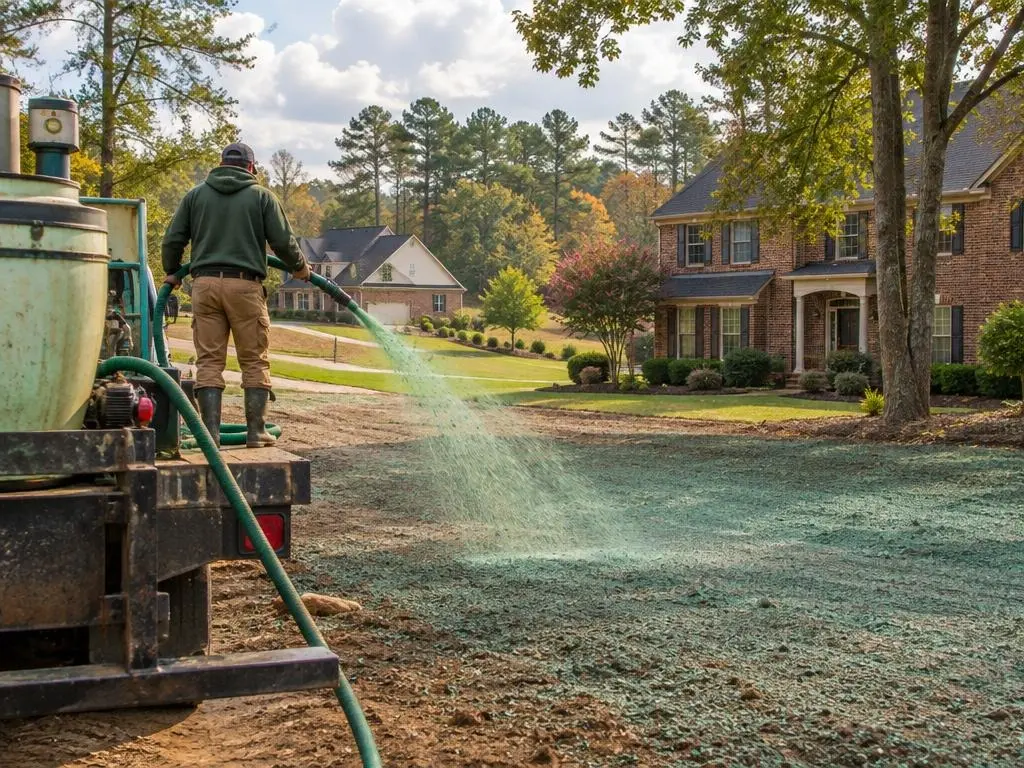
Why Homeowners Call Hydroseeding Memphis
Seed timed to the grass
Bermuda and zoysia go into warm late-spring soil; fescue goes down in the late August to mid-October window. We tell you which fits your yard and when.
Mulch rates set for slope
Flat yards get a standard hydromulch layer; banks and swales get a heavier rate or a blanket, decided on site and written into the estimate.
Soil prep before seed
Washouts filled, clods broken, topsoil added where the subsoil is showing. Seed sprayed on bad grading is money lost.
Builder-ready sediment control
Silt fence, inlet protection and final stabilization from the same crew, so the lot is covered from first cut to finished grass.
Towns We Cover Around the Bluff City
We work throughout Memphis, including Cordova, and across the rest of Shelby County in Germantown, Collierville, Bartlett, Arlington, Lakeland, Millington and the unincorporated stretch around Eads. East along US 64 and I-40 we cover Oakland, Piperton and Somerville in Fayette County, and to the north Atoka and Covington in Tipton County. Across the state line we seed in Southaven, Olive Branch, Horn Lake and Hernando in DeSoto County, and over the river in West Memphis and Marion. The ground changes as you go: bluff-top loess and ravines on the east side, fast-growing subdivisions with freshly graded lots in Oakland, Arlington and Olive Branch, older shaded lawns in Germantown and Midtown, and low, flat alluvial land on the Arkansas side where drainage matters more than slope. On the page for each town, we list what we watch for there.
- Hydroseeding in Memphis, TN
- Hydroseeding in Germantown, TN
- Hydroseeding in Collierville, TN
- Hydroseeding in Bartlett, TN
- Hydroseeding in Cordova, TN
- Hydroseeding in Arlington, TN
- Hydroseeding in Lakeland, TN
- Hydroseeding in Millington, TN
- Hydroseeding in Atoka, TN
- Hydroseeding in Oakland, TN
- Hydroseeding in Southaven, MS
- Hydroseeding in Olive Branch, MS
- Hydroseeding in Horn Lake, MS
- Hydroseeding in Hernando, MS
- Hydroseeding in West Memphis, AR
- Hydroseeding in Marion, AR
- Hydroseeding in Covington, TN
- Hydroseeding in Eads, TN
- Hydroseeding in Piperton, TN
- Hydroseeding in Somerville, TN
Common Questions
What climate zone is Memphis, TN?
Downtown Memphis is in USDA hardiness zone 8a, and much of the surrounding region is 7b. The climate is humid subtropical, with hot, humid summers and mild to chilly winters. For lawns, that places the area in the transition zone where both warm-season grasses like bermuda and cool-season grasses like tall fescue are planted.
How much does hydroseeding cost?
Published national figures for residential hydroseeding run from about 7 cents up to 35 cents a square foot, varying with which guide you read, and most companies have a minimum job fee in the $300 to $500 range. Slopes, heavy prep and added topsoil raise the price. Each service page lists published ranges, and the quote we write after walking your yard is the figure you actually pay.
Is there free hydroseeding in Memphis?
Not that we know of. Hydroseeding uses seed, mulch, fertilizer, water and a truck-mounted machine, so someone pays for it. What we do offer free is the site visit and written estimate, so you know the cost before deciding.
Is hydroseeding better than sod in Memphis?
It depends on the job. Sod is instant and suits a small yard you need finished right away. Hydroseed costs much less per square foot, covers large and odd-shaped areas evenly, and holds better on slopes, which matters on loess soil that washes easily.
Which months work for hydroseeding a Memphis lawn?
For bermuda or zoysia in sun, May through June when the soil is warm. For tall fescue in shade, late August to mid-October. Bare ground that cannot wait can be covered with a mulch-heavy mix or temporary grass and seeded for the permanent lawn later.
How long until I can walk on or mow a hydroseeded lawn?
Grass usually shows in about 5 to 7 days under good conditions. Keep foot traffic off while it establishes, and plan the first mowing at about four to six weeks, when the blades reach roughly 4 inches.
Do you also install silt fence and erosion control?
Yes. We install silt fence, inlet protection, erosion control blankets and hydromulch on builder lots and commercial sites, and we come back to seed and stabilize the ground when it reaches final grade.
What are good lawn care services to pair with a new hydroseed lawn?
Once the grass is established, a regular mowing service and a fertilization and weed program will keep it thick. We handle the start: grading, seeding, overseeding and repair of bare or washed-out areas. After the first season, most homeowners hand the lawn to a routine maintenance service.
Let's Get Your Ground Covered
We come out at no charge, look at your yard, slope or job site anywhere in the Memphis area, and put the quote in writing.